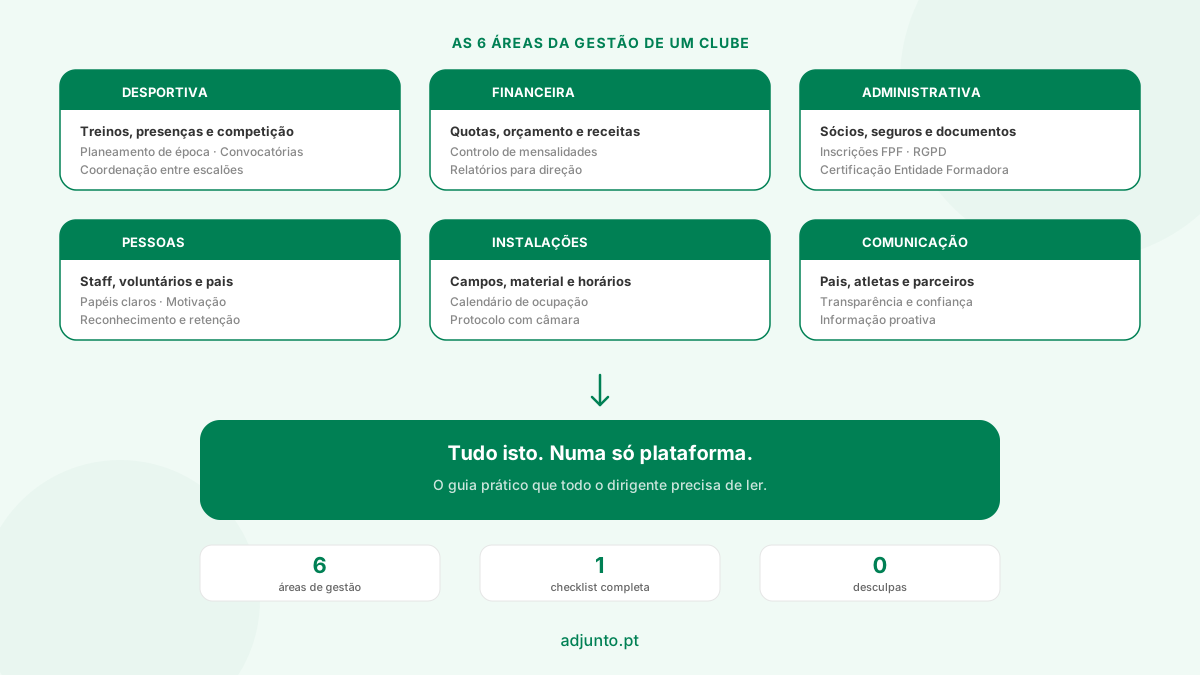
I'll be straight with you: nobody teaches you how to manage an amateur football club. You learn on the job, making mistakes, calling in favors, and solving problems at 11pm when you should be asleep.
If you're reading this, you probably know what I mean. This guide won't turn your club into Manchester City. But it will help you sleep a little better.
You don't need to run the club like a business. But if you run it like a WhatsApp group, it's going to go wrong.
⚽ The sporting side, where it all begins
This is usually the area that already works, because the coaches handle it. Your role as a board member isn't to plan training, it's to make sure there's structure around the training.
In practice, this means:
- 📋 Knowing whether there's a season plan or whether each week is improvised
- ✅ Making sure someone records attendance, because when a parent asks "why isn't my child playing?", you're going to need data
- 📣 Squad selections that don't depend on anyone's memory
- 📚 An overview of all the teams, not just the one causing the most headaches
📖 If you want to go deeper
Read the season planning guide, it's for coaches, but it helps you understand what to expect. And the article on attendance tracking explains why this changes everything.
💰 The money, the elephant in the room
Let's talk about what nobody likes to talk about. An amateur club's budget is tight, typically between €10,000 and €80,000 a year. Every euro lost to disorganization is a euro you need elsewhere.
Where the money usually comes from:
- 💶 Membership dues — the bread and butter
- 👨👩👧 Monthly fees — parents pay, if the service justifies it
- 🤝 Sponsorships — the corner pub, the local garage, the pharmacy
- 🏛️ Grants — council, regional bodies (they take time, but they exist)
- 🎉 Events — tournaments, dinners, the classic shirt auction
⚠️ Where most clubs lose money
Overdue fees that nobody collects because nobody knows who owes what. It's not bad faith, it's the lack of somewhere to see "John owes 3 months".
💡 Tip
The article on member management and dues goes into detail on how to solve this.
📋 The paperwork, the boring (but dangerous) part
Nobody joins a club board for the paperwork. But ignore this area and you'll get some nasty surprises:
- 📄 Federation registrations that close on a Friday and you only remember on Saturday
- 🛡️ Insurance that expired and nobody checked, until the day a kid gets injured
- 🏥 Medical records that should be up to date but have been sitting in a drawer since 2019
- 📊 Data protection — you hold data on minors. This is serious
👥 The people, the hardest part
Managing volunteers is one of the hardest things there is. You can't give them a raise. You can't give them a promotion. And if they get upset, they leave, taking everything they knew with them.
🔑 The only rule that matters
Treat people who work for free well. The coach who gives up 3 evenings a week for the club deserves you making their life easier, not harder. The office volunteer who comes in on Saturday morning to sort out forms deserves a public thank you.
What works in practice:
- 🎯 Everyone knows their role — sounds obvious, but in many clubs everyone does a bit of everything and nobody does anything well
- 🗣️ Talk to them — not on the WhatsApp group, in person. A 10-minute conversation per week is worth more than 50 messages
- 🙏 Say thank you — in front of others. It costs nothing
- 📱 Give them tools — nobody wants to spend their Sunday filling in spreadsheets. If there's an easier way, give it to them
The biggest threat to an amateur club isn't lack of money. It's losing the volunteer who runs the office and who nobody ever thanked.
🏟️ Pitches and equipment: pure logistics
If the pitch is council-owned (and at most clubs it is), you know what that means: shared schedules, agreements that need renewing, and that shower that never gets fixed.
- 📅 Pitch calendar — who trains where and when. Without this, there are conflicts every week
- 🤝 Council agreement — renew it before it expires, not after
- ⚽ Equipment — knowing how many usable footballs you have avoids the embarrassment of borrowing from the club next door
💡 Tip
A shared pitch calendar is one of the simplest things to set up and one of the biggest headache-savers. Try it.
📢 Communication, where trust is built
You know that parent who turns up furious because they didn't know training changed time? Or that sponsor who doesn't renew because they "never know what's happening at the club"?
Communication isn't a luxury, it's what separates a club that works from a club that people trust.
- 👨👩👧 Parents — they want one simple thing: to know what's going on. Schedules, squad lists, changes
- ⚽ Players — if they're 15, they deserve to be told things directly too
- 🏢 Sponsors — give them visibility. Send a report once a quarter. They stay, you win
- 🏛️ Council — show the club is active. Invite them to tournaments. It makes renewing the agreement easier
💡 The rule is simple
If parents need to call you to find out when training is, you've already failed. Information should arrive before the question.
🛠️ So how do I bring all this together?
Six areas sounds like a lot. But look closely: the problem is always the same, information scattered everywhere.
❌ Today
Attendance in a notebook, dues in the treasurer's head, training in the coach's Excel, squad lists on WhatsApp
✅ With organization
Everything in one place. Anyone can access it. The coach leaves, the data stays. The treasurer goes on holiday, the club survives.
💡 Tip
Two articles that complement this one: What to look for in management software and How to ditch Excel and WhatsApp
📌 The checklist: print it and stick it on the clubhouse wall
Before the season:
- ☐ Budget approved (even a simple one)
- ☐ Coaches with up-to-date licenses
- ☐ Federation registrations done on time
- ☐ Insurance active for everyone
- ☐ Pitches secured and schedules set
- ☐ At least a rough season plan
Every month:
- ☐ Attendance recorded (not made up after the fact)
- ☐ Fees checked: who paid, who didn't
- ☐ A conversation with the technical coordinator
- ☐ Medical records up to date
- ☐ Parents know what's going on
End of season:
- ☐ Accounts presented at the AGM
- ☐ Every coach has received feedback
- ☐ You're already thinking about next season (not in August)
You don't need to do everything yourself. You need to make sure everything gets done, and create the conditions for the right people to do it.
A well-managed club isn't the one with the most money. It's the one that still works when the chairman goes on holiday.